Raffle season is here! Don’t miss your chance to win $10,000 cash or a full set of Weller Bourbon. Click DETAILS to get your chance(s)!

Atrium - Why Friar Roger Bacon Mural
- Home
- Atrium - Why Friar Roger Bacon Mural
- Atrium - Why Friar Roger Bacon Mural
Atrium - Why Friar Roger Bacon Mural
Intertwining his Catholic faith with scientific thinking, Roger Bacon is considered one of the greatest sages of the medieval period.
Roger Bacon was an English Franciscan friar known for his contributions to philosophy and science in the 13th century. He advocated for educational reform, emphasizing the importance of mathematics, experimentation, and the study of foreign languages. While often presented as an early proponent of the modern scientific method, his work also reveals an interest in alchemy and occult traditions.
Bacon was born into a wealthy family, probably at Ilchester in Somerset, around 1220. He benefited from a good education and studied and taught in Paris before returning to Oxford University in 1247. Here, under the influence of fellow scholars, he turned his attention to experimental science, reasoning that such methods could be used to confirm the Christian faith.
Bacon described his intellectual biography as being divided into two distinct periods: a first “secular” period lasting until around 1257, during which he worked as an academic, and a second period, which he spent as a Franciscan friar “in the pursuit of wisdom.” As a secular scholar, Bacon pursued his academic career at two of the earliest European universities - the University of Oxford and then the University of Paris.
In or around 1257, he joined the Franciscan Order, probably in Oxford. He was a devout Christian who believed that his scientific work would aid an understanding of the world, and so of God through understanding His creation. He hoped the Franciscans would support his scholarly interests - the Oxford Franciscans had attracted prominent scholars such as Robert Grosseteste* and Adam Marsh. In the Oxford friary he continued his interest in the sciences. Study was a major part of the life of the friars, although Bacon's experimental science would have been a unique form. The friary had an excellent library so, although he was now not allowed personal possessions by the rules of the Order, he could still continue his scientific pursuits.
*Robert Grosseteste was a diocesan priest, teacher at Oxford, and later Bishop of Lincoln. He was a great friend of the friars.
The beginning of the 1260s found Bacon again in Paris. For about 10 years Bacon had no personal contact with the outside world although he was able to correspond by
letter. Bacon's activities were restricted by a statute prohibiting the friars of his order from publishing books or pamphlets without prior approval.
In 1266, Bacon sent Pope Clement IV a letter containing proposals covering the natural world, mathematics, languages, perspective, and astrology. Bacon argued that a more accurate experimental knowledge of nature would be of great value in confirming the Christian faith, and felt that his proposals would be of great importance for the welfare of the church and of the universities. The Pope desired to become more fully informed of these projects and commanded him in June 1266 to send the work previously requested “notwithstanding any prohibitions of his order.” Bacon began writing his Opus Majus (Great Work) and followed this up with his Opus Minus (Smaller Work) and his Opus Tertium (Third Work). In these works, he strongly advocated the reform of education, arguing that the best means of understanding the world’s Creator was by close observation and precise measurement of the natural world.
In addition, he held that more emphasis should be placed upon the learning of languages, and the study of mathematics, alchemy, astronomy and the physical sciences. Unfortunately, Pope Clement IV died in 1268, putting an end to any immediate recognition of scientific subjects in the academic world.
After the Pope died, hope for Bacon’s plans diminished, but not his enthusiasm for science. He continued to write on the value of experiment, and made remarkable predictions of what science could accomplish: powered ships and vehicles, eyeglasses and other inventions. He wrote that the earth was a sphere and that it would be possible to sail around it. He estimated the distances to stars, and encouraged mathematical rigor for good scientific work.
At age 64 (between 1277 and 1279) he was put under house arrest in the convent in Ancona, Italy by the Franciscans’ Master General Jerome of Ascoli. The charge against him was that some of his doctrines contained “certain suspected novelties” – possibly relating to his teachings on alchemy, astronomy, experimental science, or his radical spiritual leanings. Bacon's views were sometimes controversial and led to accusations of heresy.** In Ancona, friars who had views with which their superiors disagreed were put in solitary confinement and not allowed to speak even to their guards for fear their views would have influence. They were refused confession and denied absolution - their superiors believed (and so did the imprisoned friars) they would go to hell for all eternity.
**Not only was he imprisoned, but he was also declared a “heretic.” This is the key reason many of his writings in the Oxford Library were destroyed. Roger Bacon was a prolific writer and seemingly was writing something all the time. It was also a strong contributing reason why it was so difficult to gain any respect, even after his death.
A change in the Franciscan leadership in 1290, however, saw Raymond of Guafredi take control of the Order, and he released the prisoners in Ancona. Although there is no explicit evidence that Bacon was among these men, it seems very likely that he was and he must have returned to England as soon as he could.
From his writings it is clear that Bacon had always argued for what he believed and against those he believed to be wrong. He continued to state his views even after suffering at Ancona – including on what was, in all likelihood, his last treatise, Compendium Studii Theologie, until his death in 1292 in Oxford.
Because of his particular interest in practical science, a number of inventions have been attributed to him - such as lenses for spectacles - and he has been credited with the means of making gunpowder and of foreseeing the invention of the flying machine (with flapping wings), and the mechanically-driven ship and carriage. It is perhaps not surprising that he was thought by some to have magical powers and dubbed the scholastic accolade “Doctor Mirabili” (Wonderful Teacher) - a title that did not go well in the Church. It is now known that he gleaned many of his far-reaching ideas from others, but, nonetheless, he did make a contribution to scientific thought and his influence in this field was considerable.
Significant writings of Bacon which survived include:
- Opus Majus (1267)– His most famous work, sent to Pope Clement IV, covering topics like optics, alchemy, and the scientific method.
- Opus Minus (1267) – A summary and supplement to Opus Majus.
- Opus Tertium (1268) – Another follow-up to Opus Majus, providing additional insights.
- The Mirror of Alchemy (published in 1597) – A treatise on alchemy and its principles. It contains Bacon's thoughts on the relationship of science and religion. Bacon points out that the pursuit of knowledge is not incompatible with faith. Furthermore, he argues that science and religion could be mutually supportive. From this perspective, the "Mirror of Alchemy" can be interpreted as an early attempt to reconcile the seemingly opposing forces of science and religion.
- Perspectiva (published in 1614) – A work on optics and vision.
- De Nigromancia – A text discussing magic and necromancy.
For a more in-depth look and the life and work of Friar Roger Bacon, click on the following downloadable files below:
Opus Majus
Opus Minus and the Seven Sins in the Study of Theology
The Relationship of Religion and Science
Scientific Method
Gunpowder
Magnifying Glass
Optics
Language
Astronomy
Roger Bacon - Wizard
Astrology
Alchemy
Folly Bridge
Oxford England Inscriptions - Roger Bacon; Westgate Centre
Armillary Sphere
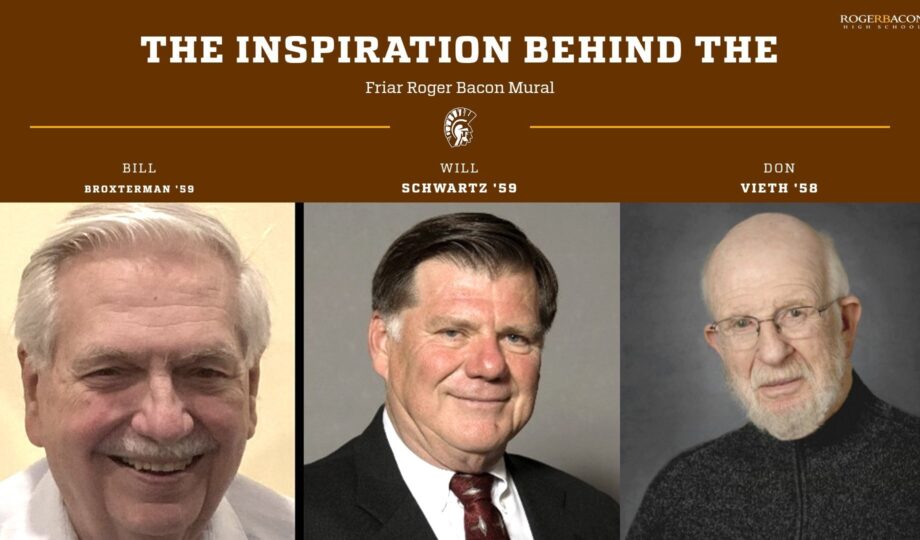
We are indebted to the following Roger Bacon alum who inspired the work on Roger Bacon:
Bill Broxterman ‘59
Bill Broxterman is a Cincinnati native who attended St. Bonaventure Church and grade school before enrolling at Roger Bacon High School, where he graduated in 1959. He went on to Xavier University, earning a B.S. in Chemistry in 1963 and an M.S. in 1965. He later attended Purdue University, where he earned his Ph.D. in Chemistry in 1969.
Bill began his professional career with Dow Chemical Company as a Research Chemist. Over time, his career evolved from basic research to new product development and ultimately to new business development. In 1990, he founded ChemQuest Group, an international business management consulting firm specializing in the coatings, adhesives, and sealants industries.
While a student at Roger Bacon, Bill recalls never learning much about the man for whom the school was named. Decades later, at the age of 81, his curiosity about Roger Bacon resurfaced—this time with the time and interest to explore it more deeply. What began as a casual inquiry grew into a year-long investigation. As his research progressed, Bill became increasingly fascinated by this 13th-century scholar, recognizing him as a thinker far ahead of his time. One historian aptly described Roger Bacon as a 16th-century scientist mistakenly placed in the 13th century. Though his genius was not fully appreciated during his lifetime, later scholarship has recognized him as one of the most significant scientific minds of the Middle Ages.
At the conclusion of his research, Bill compiled his findings into a narrative and generously shared it with Roger Bacon High School for future use—an enduring contribution that reflects both his intellectual curiosity and his lasting connection to his alma mater.
Will Schwartz ‘59
Will, a Cincinnati native, came to Roger Bacon from St. Gabriel Parish. He attended the University of Cincinnati, where he earned a Bachelor of Business Administration in 1964 and a Master of Business Administration in 1970. His undergraduate cooperative education experience focused on the economics of energy utilities, helping shape his early professional interests.
In 1964, Will joined IBM’s Cincinnati energy and communications industries unit, where he advanced through the organization and eventually led the division. In 1976, he transitioned to Prudential, joining a specialized group focused on the capital needs of energy utilities. Over time, he assumed a variety of leadership roles across finance, insurance, and real estate organizations, building a distinguished career in multiple sectors.
Will commented: “Sputnik occurred early in my junior year. Among other things, Sputnik engendered discussions on education and how to best increase society’s knowledge base. Commenting on the latter in a History class, Brother Chris said ‘… anyone interested in the history of knowledge creation would do well to start their search with Roger Bacon.’ That sent me to libraries. My search was disorganized, intermittent, and life lone. Throughout my business career as the problems became more conceptual rather than concrete my appreciation for Doctor Mirabilis grew exponentially.”
Donald Vieth ‘58
Donald L. Vieth was born in Cincinnati and raised in College Hill, where he attended St. Clare Parish and School. A proud member of Roger Bacon High School’s Class of 1958, he was later honored by his alma mater with the prestigious Astrolabe Award. He went on to attend the University of Cincinnati, earning a B.S. in Metallurgical Engineering in 1963 and a Ph.D. in 1972. While at UC, he was a member of Tau Beta Pi, and in 1985 the university recognized him as a Distinguished Alumnus.
A professional engineer, Don devoted his career to public service and scientific leadership. He began in 1963 at the National Bureau of Standards, where he rose to become Special Assistant to the Director. In 1975, he joined the Energy Research and Development Administration, and when that agency became the U.S. Department of Energy in 1976, he continued serving in important roles related to nuclear energy.
In 1982, Don and his family moved to Las Vegas, where he became Director of the Yucca Mountain Project. In that role, he was affectionately known as “Captain Waste.” He also participated in the Presidential Executive Exchange Program from 1989 to 1990. Don continued in a number of senior leadership roles with the Department of Energy in both the Las Vegas field office and at the Richland site until his retirement in 1998. Even after retiring, he remained active in supporting the Department of Energy as a contractor on special projects.
Later in 1998, Don and his wife, JoAnn, returned to the Cincinnati area and settled in Maineville, where they enjoyed being close to family and friends. Don passed away on May 8, 2025. As a final act of love and charity, he donated his body to the University of Cincinnati College of Medicine Body Donation Program, reflecting his lifelong commitment to science, education, and service.